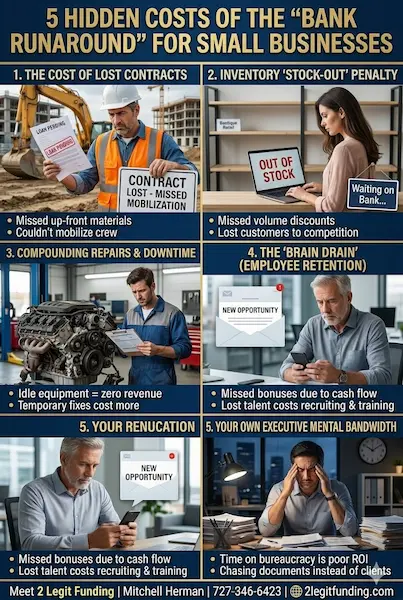
5 Hidden Costs of the “Bank Runaround” for Small Businesses
In 2026, the phrase “time is money” has never been more literal for American small business owners. While national banks and traditional lenders are busy updating their risk algorithms and requesting “just one more” set of documents, the actual economy is moving at light speed.
When you are stuck in the “Bank Runaround” (that 30, 60, or 90 day purgatory between application and funding), you aren’t just waiting for a check. You are paying a hidden tax on your growth.
Here are the five invisible costs that are draining your business while you wait for a traditional loan approval.
1. The Opportunity Cost of Lost Contracts
In industries like construction, logistics, and wholesale, the best contracts go to the firms that can mobilize immediately. If a prime contract opens up but requires an upfront investment in payroll or materials, and you are three weeks into a six-week bank review, you’ve already lost the bid.
The cost: The total lifetime value of the contract you couldn’t sign because your capital was “pending.”
2. The Inventory “Stock-Out” Penalty
For retail and e-commerce businesses, inventory is life. When a supplier offers a 15% discount for a bulk cash purchase, or when a sudden trend causes a spike in demand, you need to pounce.
Waiting for a bank means missing those volume discounts or, worse, seeing “Out of Stock” on your website while your competitors scoop up your customers. In 2026, customer loyalty is thin; if you don’t have the product, they won’t wait for you.
3. Equipment Downtime and Compounding Repairs
When a critical piece of machinery or a delivery vehicle goes down, every hour it sits idle is lost revenue. Traditional bank loans are not designed for emergencies. By the time a bank approves a loan for a new refrigerator or a CNC machine, you’ve likely lost thousands in production capacity and spent a fortune on “band-aid” temporary repairs.
4. The “Brain Drain” (Employee Retention)
The 2026 labor market remains hyper-competitive. Your best employees need certainty. If you are struggling with a temporary cash flow gap due to slow receivables and you are waiting on a bank to cover payroll, the stress trickles down.
When top talent senses financial friction or experiences a delayed bonus, they start looking at other options. The cost of recruiting and training a replacement is far higher than the cost of fast, short-term funding.
5. Your Own Executive Mental Bandwidth
This is the cost most owners forget to calculate. Every hour you spend chasing down 24 months of P&L statements, answering redundant questions from a junior loan officer, and stressing over a “maybe” is an hour you aren’t spending on sales, strategy, or innovation.
Your time is the most expensive resource in the company. Spending it on a bank’s bureaucracy is a poor ROI.
The 2026 Alternative: Velocity over Bureaucracy
The modern business landscape favors the fast. Revenue-based funding has become the national standard for entrepreneurs who understand that velocity of capital is more important than a slightly lower interest rate that comes three months too late.
At 2 Legit Funding, we don’t do the runaround. We look at your revenue, verify your sales, and get you the capital you need in 24-72 hours.
No collateral. No bureaucracy. No waiting for the world to pass you by.
Stop paying the “waiting tax.” Get the capital to grow your business now.
Mitchell Herman 2 Legit Funding 727-346-6423
#BusinessGrowth #SmallBusinessFinance #CashFlow #Entrepreneurship2026 #BusinessTips #RevenueBasedFunding #2LegitFunding #NoCollateral