Construction Cash Flow: How to Fund Your Next Project Before the Draw Hits
Across the United States, the construction industry is facing a paradox in 2026. Backlogs are strong and infrastructure demand is high, but liquidity is tighter than ever. Whether you are framing a multi-family complex in the Sunbelt or handling a municipal retrofit in the Midwest, you are likely playing a dangerous game: The Waiting Game.
Revenue is rarely the problem for a successful firm—it is the timing of that revenue that breaks businesses. The gap between starting a project and receiving your first milestone draw is a cash flow canyon. If you don’t have the liquidity to cross it, you can’t take the job.
The 2026 Liquidity Trap
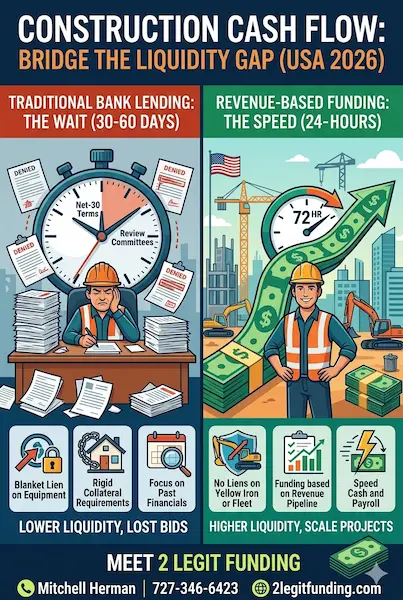
Traditional banks are currently operating with a “look back” mentality. They want to see two years of steady tax returns and significant hard collateral. But the 2026 construction market moves forward, not backward. With material costs for steel, copper, and aluminum up over 12% annualized in early 2026 due to shifting trade policies and tariffs, your 2024 tax returns are irrelevant to today’s job costs.
Banks don’t understand that you need $75,000 for materials on Monday so you can finish the phase that pays out $200,000 next month.
The Solution: Revenue-Based Funding as a Bridge
Revenue-based funding is the strategic tool modern contractors use to bypass the bank. It treats your proven revenue and project pipeline as the asset, not your personal home or equipment fleet.
1. Stop Waiting on the Draw
Project owners and government agencies are notorious for slow draws. You shouldn’t have to stall a project or delay a start date because a client is “processing the paperwork.” With 24-72 hour funding, you keep the momentum. When the draw finally hits, you’ve already cleared the phase and kept your schedule intact.
2. Payroll is the Priority
In a tight 2026 labor market, your crew is your most valuable asset. They don’t care about “Net-30” terms; they need their checks on Friday. Using a cash advance to ensure payroll is met keeps your best subs and trades on your site and off your competitor’s.
3. Hedge Against Material Volatility
With the current volatility in metal and lumber prices, the quote you got yesterday might not be valid next week. Accessing capital immediately allows you to lock in pricing and buy in bulk. This move alone often saves more in material costs than the cost of the funding itself.
The “No Collateral” Advantage
The greatest risk in traditional construction lending is the “blanket lien.” Banks often want to tie up your equipment, your receivables, and sometimes your personal real estate.
At 2 Legit Funding, our revenue-based model is designed to be high-speed and low-friction:
- No liens on your yellow iron or fleet.
- No risking your personal residence.
- Funding based on the actual cash flowing through your business.
Scale Without the Stress
The ceiling on your growth is usually defined by how many projects you can float at once. If you can only afford to carry the upfront costs of two jobs, you are stuck. By utilizing flexible, fast capital, you can scale to four or five projects simultaneously, knowing your working capital is secure.
In 2026, the firms that win are those that can deploy capital as fast as they can deploy a crew. Don’t let a slow draw hold your firm back from its next big win.
Stop waiting for the client to pay. Get the funding you need to break ground today.
Mitchell Herman 2 Legit Funding 727-346-6423
#ConstructionFinance #ContractorLife #CashFlowSolutions #Build2026 #RevenueBasedFunding #SmallBusinessGrowth #2LegitFunding #NoCollateral